We are soon introducing art licensing and registration in Nepal

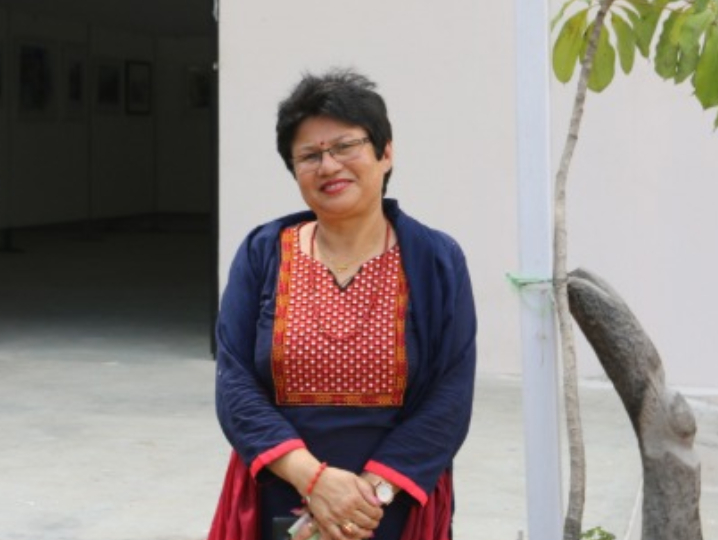
Sushma Rajbhandari was heavily inspired by the paintings of Bhajuman Chitrakar (also known as Bhajumacha Chitrakar) since childhood. As a curious child, she always asked about paintings, especially his portrait of Jung Bahadur Rana painted by Bhajuman hung on a wall of her house. In that painting, made by Bhajuman imagining the scenario during the establishment of Kalmochan Temple, she could clearly distinguish the words and each alphabet written using gold. Besides Bhajuman’s paintings, the mythological stories of Lord Ganesh also influenced her a lot, which we can see today in her paintings.
And it was Bhajuman’s painting, which made Rajbhandari wonder what it would feel like to pursue this field. The influence of her great grandfather, Tej Man Rajbhandari, also was the reason for her pursuing art. From an early age, she got art (sketching) lessons from Govinda Dangol too. Later, she pursued art at Nepal Lalitkala Campus after realizing her keen interest in art. She has done numerous solo art exhibitions both nationally and internationally. Today, Rajbhandari is associated with Nepal Academy of Fine Arts (NAFA) since 2063/64, serving currently as Head of Paintings and also Council Member. Canvas’ Monica Lohani talked about art, legalities, and art licensing and registration in Nepal. Excerpt:
Please tell us about your role in this institute and the initiatives you are working on.
The main objective of this institute is to develop art and develop the culture of respecting Nepali artists just like in foreign countries. Artists are highly respected in foreign countries. NAFA organizes various exhibitions to showcase the talent of artists across the country. We also help to hold art exhibitions abroad. We also publish research books. And as I am the head of the Painting Department, art forms like printmaking, abstract paintings, modern paintings, traditional paintings like Thanka, Pauwa and all things related to them fall under my responsibility.
As an active board member, I participate in making policies and programs for the development of Nepali art and artists. The council members themselves put every effort into developing the traditional Nepali art and handicraft resources like bricks, and Nepali Kaagaz. We are preparing to send a team of Nepali artists who are soon going to the Maldives to participate in an art exhibition of SAARC countries. And also we are working on bringing licenses and registration for artists in the county, to regulate the field better.
How will NAFA help the artists with this new art licensing and registration policy in Nepal?
In foreign countries, art licensing and registration is already done. Art licensing and registering will be very helpful to Nepali artists, especially in foreign lands, and I have experienced that personally. It will give them the identification of being Nepali artists and further help them with their personal and professional artistic journey. What we have so far is a book, more like a bio-data, that has names and artworks of various artists. But there are many upcoming artists who are to be added to the list.
Nepal Academy of Music and Drama (NAMUDA) has already started licensing. And, we will begin this soon too. But first, we will have to prepare a draft. There are various artists, from newcomers to veterans. We cannot provide the same license to everyone as it will have no meaning. So keeping that in mind, we are working on statute, policies, and procedures for what kind of licenses will be provided to whom. And the parameters would be their works, number total or solo exhibitions conducted and other factors.
As you said, the draft is being made. What does the draft say? What would the policy include and what would be the procedures? Do artists know about this?
We are preparing the criteria. Criteria for what kind of artist will be given what kind of licenses. A few of them have been finalized already. Things like ‘Who do we consider as artists?’ ‘How many solo exhibitions must be done for the same?’ Some of them might have studied fine arts, others might be a born artist who has been doing artworks, Thankas, Pauwa, etc.
Of course, license for upcoming artists will be very different from the license for veterans, or license for born artists. We are preparing criteria for every category. It will be finalized by the end of this year.
And yes, artists are aware of everything regarding this. Moreover, information can be gathered from our social media sites, websites, emails as well. Meanwhile, we are visiting different parts of the country and making artists aware of licensing too.
What if two or more people painted something? What kind of license will be given to them?
There might be various such cases. So, an institutional license will be given to them. If someone has painted it in a group, they will have to register under the institutional category. NAFA also organizes awards shows for artists. If you are wondering how the artwork of such artists will be categorized for award, they will be nominated under institutional category and awarded accordingly.
Do we have enough manpower or artists in Nepal? How is NAFA helping art- entrepreneurs?
Yes, we do. But, female artists are still a few in numbers. Earlier there was a different scenario. There were many initially but, after marriage, they just quit. There are numerous such cases; they just disappear.
At present, there are many art schools and colleges. So, the number of female artists has increased. But even recently, we organized a painting exhibition named ‘Women Season’, we had to go to the doorstep of women artists and ask them to showcase their artworks for the exhibition.
NAFA has come across many art-based entrepreneurs, though not enough, and does its best to help them. We mostly help them in publishing books, make some donations, or help them open their own factories and hold exhibitions.
What if two or more people painted something? What kind of license will be given to them?
There might be various such cases. So, an institutional license will be given to them. If someone has painted it in a group, they will have to register under the institutional category. NAFA also organizes awards shows for artists. If you are wondering how the artwork of such artists will be categorized for award, they will be nominated under institutional category and awarded accordingly.
Do we have enough manpower or artists in Nepal? How is NAFA helping art- entrepreneurs?
Yes, we do. But, female artists are still a few in numbers. Earlier there was a different scenario. There were many initially but, after marriage, they just quit. There are numerous such cases; they just disappear.
At present, there are many art schools and colleges. So, the number of female artists has increased. But even recently, we organized a painting exhibition named ‘Women Season’, we had to go to the doorstep of women artists and ask them to showcase their artworks for the exhibition.
NAFA has come across many art-based entrepreneurs, though not enough, and does its best to help them. We mostly help them in publishing books, make some donations, or help them open their own factories and hold exhibitions.
Besides your responsibilities as the Head of the Painting Department at NAFA, what are your personal involvement in the field of art and paintings?
I, not only consider myself an artist but also an art collector. I also make paintings, especially of Lord Ganesh. And, I love collecting artworks made by various other artists. I love sculptures too and have collected some refined pieces at home. So far, I have visited 25 countries and observed the artworks there, collect a few too. The art sector has developed a lot in countries like Japan, South Korea, the USA, in Europe, among others. They value art and respect artists a lot. This has given me a lot of ideas to improve the art sector in Nepal.
I was the Head of the Handicraft Department earlier. Even back then, I was focused on uplifting and encouraging the artwork and handicraft of Kuswadi, Kiranti, Raute communities who have a legacy in handicrafts.
You have been in this sector for many years. What is that one dream you still want to pursue but have not gotten any chance yet?
My dream is to open an art village in Nepal. I want to buy a hill and turn it into an art village. There are many countries like Denmark, Japan, the USA, where artists have turned a village into an art village. And these art villages are huge. One day is not enough to visit the whole village, in fact, we have to board a rickshaw to roam around. I want to create an art village here. And I am working on it.
Leave a Comment
Your email address will not be published. Required fields are marked *